
In this edition of the Future of Work and Learning, Jeff Griffiths offers insights from the first two of a six-report series on productivity. The series focuses on challenges facing the labour market as rapid technological advancements and globalization reshape regional economies. The first two reports were made public in September with release of the other four staggered between now and November. Together, the series addresses a pivotal question – How can human capital drive Canada’s productivity?
Read the Reports
The evidence is overwhelming. The vast majority of workers will require upskilling, or even complete re-skilling, multiple times over the course of their careers as technological changes and shifting global conditions force major upheavals across all industries and occupational categories. Nobody will be immune.
In today’s workplace, technologies are pervasive and ubiquitous, available off the shelf to any organization that can pay for them. In this new reality, the main differentiator for productivity is, increasingly, human capability. However, our paradigms for developing workforce skills are inadequate to address an economy where agility, flexibility and responsiveness are the key determinants of success.
Robert Luke, the CEO of e-Campus Ontario, has said that our workforce generation system is stuck in a “12-21” conundrum – a system designed in the 12th century that is simply incapable of addressing the needs of the 21st century and beyond. This system, which is anchored in a post-secondary system of degrees, diplomas and certificates conferred by universities, colleges and vocational schools, served us well until the information technology explosion which started in the 1980s. It has ceased to be agile enough to keep up with a rate of change that is ever-accelerating.
In a collaborative effort, a team of researchers and authors led by Dr. David Finch (Mount Royal University), and including me, former CWF director Janet Lane and others (a complete list is below), looked at the implications of the human capital ecosystem on future productivity and prosperity and how shortcomings can be addressed. The underlying research has been ongoing for the last five years, and has culminated in a series of six papers collectively called The Productivity Project.
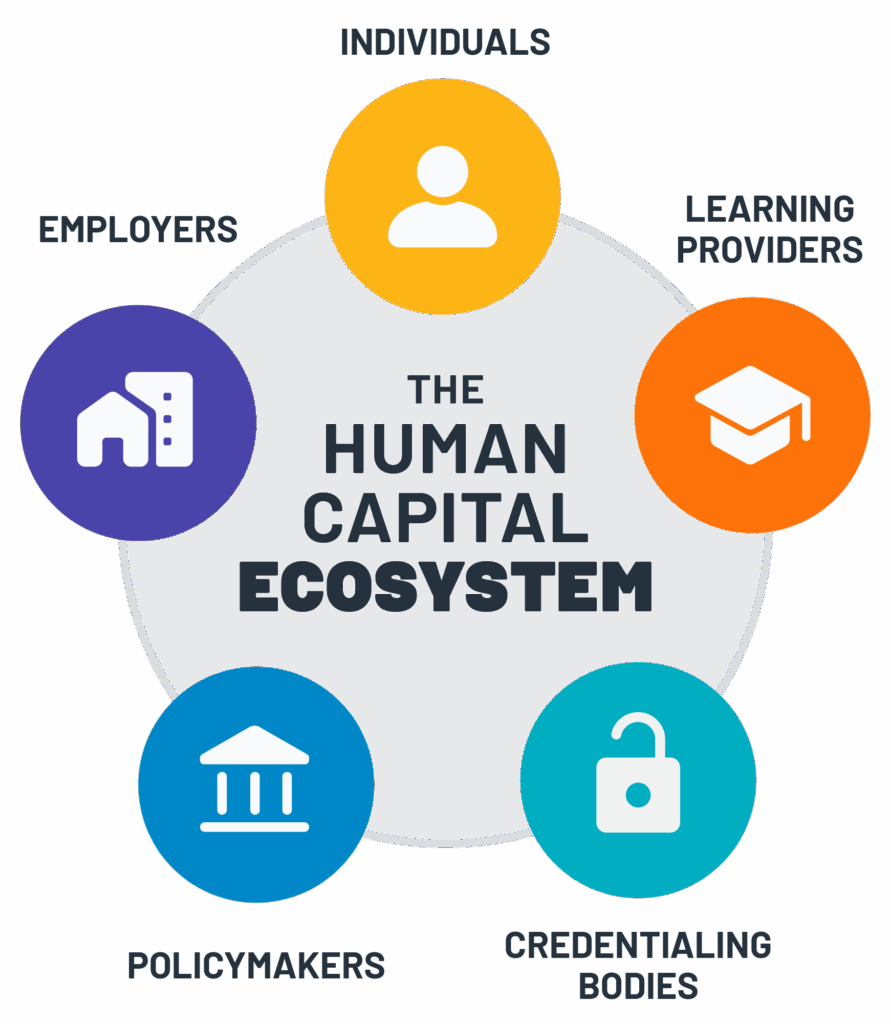
The first two papers in the series, Productivity and People and The Coming Storm, were released on Sept. 2 and break down the problem we face and the opportunity it represents. These first reports identify five core stakeholders in regional human capital development and deployment ecosystems – individuals, learning providers, credentialing/recognition bodies, policy makers and employers – who, if they work together, can generate value beyond what they would individually.
The Human Capital Ecosystem
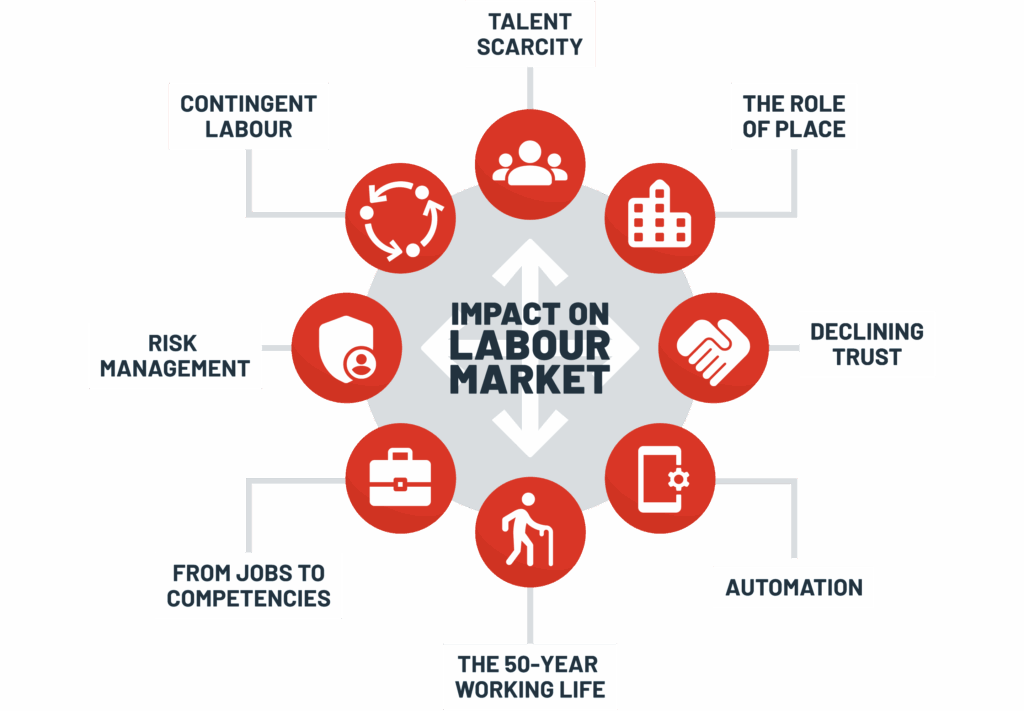
Report two in the series identifies eight disruptive forces (see figure below) that make current approaches to workforce training and hiring increasingly untenable. These are:
- the role and importance of place
- declining trust in institutions
- automation (in all its forms)
- the “50-year working life”
- a growing shift from discrete jobs to flexible ‘collections of competencies’
- risk and risk management
- the rise of contingent labour
Eight forces reshaping labour markets
The series of reports also identifies both the challenge and the unique opportunity these conditions represent for a fundamental re-think of our current approaches to workforce generation and maintenance. It is critical that we ensure the needs of the economy – as represented by individual workers and their employers – are better served through a system that offers greater flexibility and choice on how, where, when and by whom skills and competencies are learned, assessed and credentialed.
Based on meta studies of experiments and pilots being conducted in different jurisdictions around the world, as well as empirical data on the learning ecosystem in the Calgary metropolitan region, The Productivity Project presents a toolkit that the stakeholders can use to address the eight factors in a integrated, “made here” manner that will allow individuals to become and remain economically viable, and where all learning can be recognized and valued.
These foundational ideas aren’t new and markets are starting to respond. It’s long been recognized there is a growing need for micro-learning, spurring the growth of quality, low-cost online platforms that provide learning opportunities outside the traditional post-secondary institutions. Similar is the push for “micro-credentials” to meet the demand for upskilling, though these programs are often disconnected from employers’ needs and tied to existing post-secondary institution programming, not just in Canada but globally.
Ultimately, identifying the critical forces and the tools available to mitigate them will enable a set of policy levers that can help resolve systemic problems impacting Canadian productivity and, by extension, individual and collective prosperity.
The unbundling of the current paradigms is overdue: a fresh approach is needed. The future of the economy depends on it.
Project authors
Productivity Project authors include Dr. David Finch (Mt. Royal University – MRU), Dr. Chad Saunders (University of Calgary), Dr. Nadège Lèvallet (University of Maine), Dr. Sharon McIntyre (New Cottage Industries), Dr. Stephen Murgatroyd (University of Alberta), Dr. Irina Dowbischuk (Mount Royal University), and Janet Lane and Jeff Griffiths (Canada West Foundation), and with the support of the Alberta Centre for Labour Market Research (Dr. Joseph Marchand), MRU’s Institute for Community Prosperity, the Learning City Collective and the Canada West Foundation.
The Future of Work & Learning Brief is compiled and written by Jeff Griffiths and Stephany Laverty. Subscribe and stay on top of developments in the workforce and how education and training are changing today to build the skills and competencies needed for the future.
The Canada West Foundation’s impact is made possible by people like you. As a donor-supported think tank, your contribution helps us champion practical solutions that strengthen the West and benefit all of Canada.
JOIN US — your support truly matters.